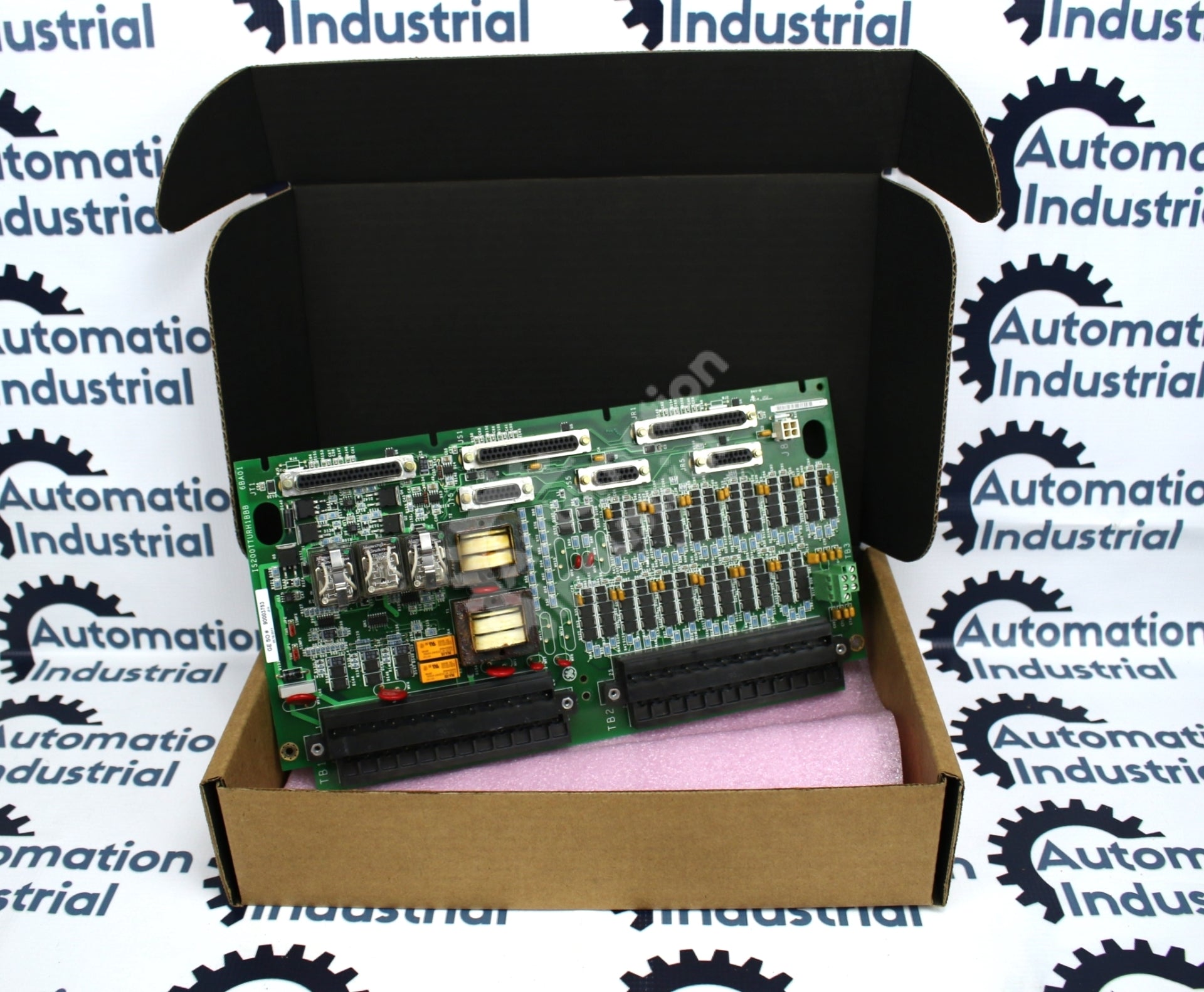
IS200TTURH1BBB and the Turbine Speed Signal Path
Speed sensing is one of the two big jobs handled by the IS200TTURH1BBA — sorry, the IS200TTURH1BBB — GE's Turbine Termination terminal board for the Mark VI Speedtronic system. In a simplex configuration, the board can accept up to four passive magnetic pickups sensing a toothed wheel to measure turbine speed; in a TMR system, all speed inputs fan out to the three control racks, and the R, S, and T readings are voted before they're allowed to influence permissive relays. Field wiring for these pickups, along with shaft voltage/current sensors and potential transformer leads, terminates on two 24-position screw terminal blocks, TB1 and TB2 (rated up to #12 AWG wire), with an optional third block, TB3, available for TTL active speed pickups that need external power.
The TTUR itself is a terminal board — the physical termination point for this wiring — while the control logic that actually processes these signals runs on a separate VME card called VTUR, installed in the R/S/T Control Module. The two communicate over a cable running to six D-type connectors on the TTUR: JR1/JR5, JS1/JS5, and JT1/JT5. The same board also handles generator synchronizing, driving the 125 V DC breaker coil (52G) through the K25/K25P/K25A permissive relay chain once turbine speed and generator/bus voltages line up.
Speed and Overspeed Alarms: What to Check First
Before ordering a replacement board over a speed-related alarm, it's worth ruling out the more common causes:
- Check the air gap and mounting of the magnetic pickups themselves, along with the cable run back to TB1/TB2/TB3 — a drifted pickup or damaged cable is a far more frequent cause of erratic speed readings than a board fault.
- In TMR systems, a voting/disagreement alarm between R, S, and T channels usually points to one bad pickup or wiring run, not a terminal board failure across all three.
- If the alarm involves synchronizing rather than speed, check the PT wiring and fuses, the external synch check relay, and the JP1/JP2 jumper settings for simplex/TMR mode.
- If you're seeing shaft voltage or current alarms, that typically traces to a grounding brush or bearing insulation problem on the shaft itself — not a defect in this board.
Reading the IS200TTURH1BBB Part Number
IS200 is the platform prefix, TTUR the function code, and H1BBB the group and revision — H1B for the group/generation, BB for this specific revision. Order against the complete string, since the H1B and H1C TTUR groups stocked in this collection are separate hardware generations, not interchangeable by function code alone. Our GE Speedtronic Part Number Decoder covers how to read a full IS200 string.
Related Boards
Inside the Control Module, the TTUR pairs with the VTUR VME card. The generator breaker trip circuit also involves the TRPG terminal board (driven by VTUR) and the TREG terminal board in the Backup Protection Module (driven by VPRO). If you also maintain Mark V equipment, see our Mark V vs Mark VI: DS200 to IS200 guide and GE Mark V DS200 Boards Explained article. Browse the rest of the family in our GE Mark VI IS200 Boards collection or the wider GE Speedtronic Turbine Control Boards collection.
What to Include in Your Quote Request
- Full part number with suffix: IS200TTURH1BBB
- Revision from the label
- Photo of the ID label
- Turbine/generator model and unit ID
- Planned outage or urgent need
- Quantity
Request a Quote
This IS200TTURH1BBB is listed in used condition, cleaned and tested, with a 1-year warranty (see table below). We quote every order directly rather than publishing prices — submit a Request a Quote and expect a reply within 24 hours. We ship worldwide DDP, accept purchase orders, and support both planned outages and urgent breakdown needs.
General Information about the Product |
Part Number |
IS200TTURH1B Mark VI IS200 |
Description |
GE General Electric IS200TTURH1B IS200TTURH1BBB Termination PC Board Mark VI |
Condition |
used Cleaned and Tested. With 1 Year Warranty. |